Regret Ledger
A calculator for debts never agreed to be owed. Compare two choices by the regret they're likely to leave behind, then keep track of what it actually costs you.
Regret is a creditor you never signed with. It doesn’t send one bill; it charges interest, and the interest is paid in rumination. I wrote an essay about the arithmetic of that debt, and at some point the arithmetic wanted to be used on something real. This is where it went.
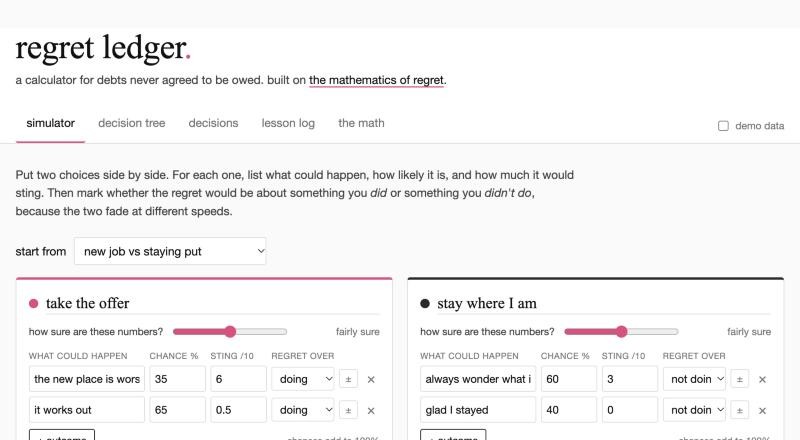
You put two choices side by side, list what could go wrong with each, and say how much it would sting. Then you mark whether you’d be regretting something you did or something you didn’t do, because the two are not paid off at the same rate. The ledger shows how each balance builds and settles over the years, and which one ends up lighter.
what’s in the ledger
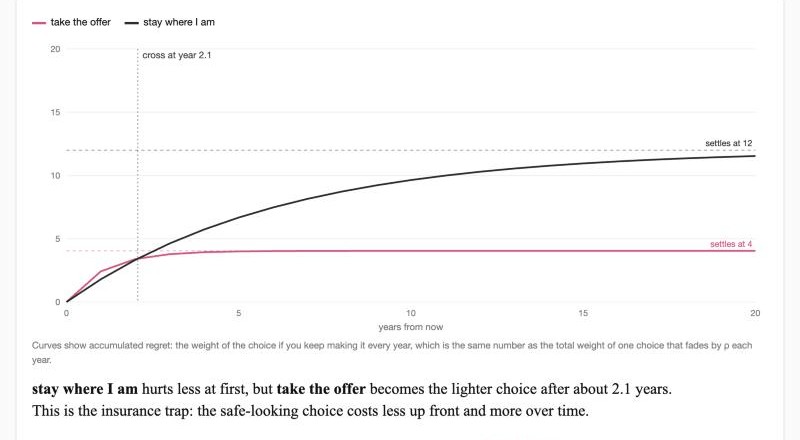
- The simulator. Each year’s sting adds to whatever is left of last year’s: Et = R̄ + ρEt−1. In plain English, ρ is the share of the debt you carry forward. It finds the year the safe-looking choice quietly becomes the heavier one, which is the insurance trap: small premiums now, a large balance later.
- Uncertainty. Nobody knows their own numbers. Give any of them a range and the ledger runs 10,000 versions of your life, reports how often each choice comes out ahead, and tells you which unknowns are actually worth chasing before you decide (and which are not).
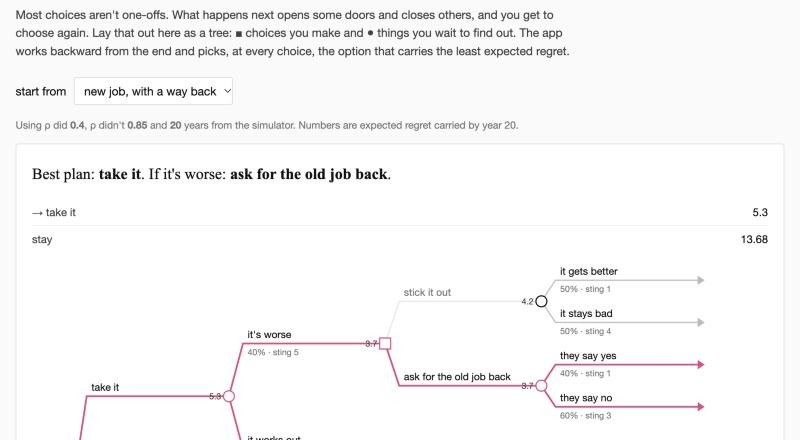
- Decision trees. Most choices open the door to more choices. Lay them out, and the ledger works backward from the end to find the plan that carries the least regret.
- The books. Save what you chose and how much you think it’ll sting. Rate it later. Over time the app learns whether you overestimate, and fits your own ρ from how fast your regrets actually fade, so you stop borrowing someone else’s.
a note on the fine print
Constant decay is a simplification, not a law of how people heal, and the numbers are your guesses about yourself. The ledger doesn’t tell you what to do. It shows you the assumptions you were already making, with the interest written in.
It’s plain JavaScript built with Vite. Everything stays in your browser, with export and import for backups.