SonaSight
A film camera for Android, made for quick, good-looking pictures while travelling.
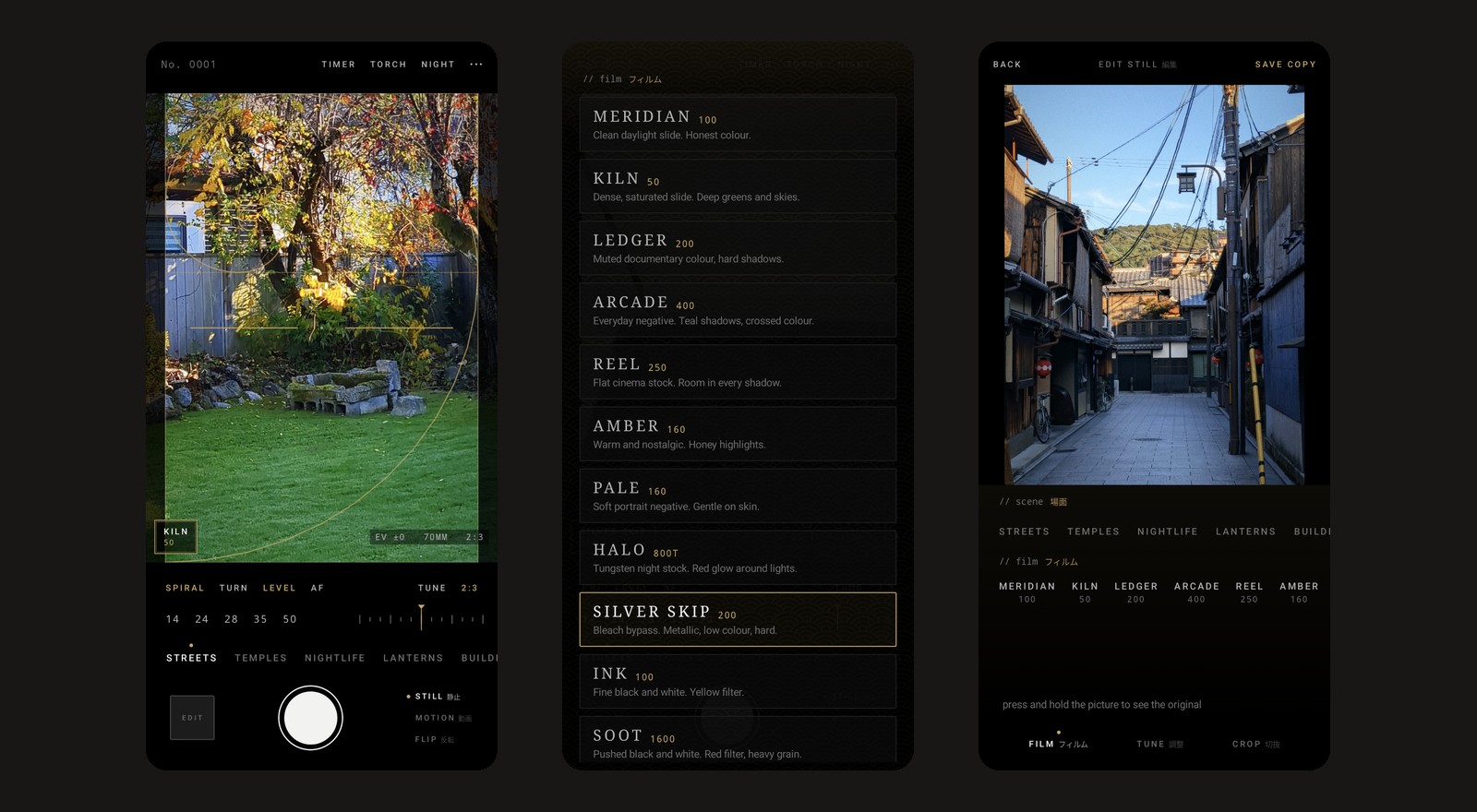
SonaSight is a camera app I built for taking quick, good-looking pictures while travelling. The viewfinder is already developed, so what you see is what the photo or video will look like. You pick what you’re pointing at, like a street, a temple or lanterns at night, and it sets up the film, lens and framing for it.
What it does
- Film looks. Eleven film stocks, from clean daylight slide to pushed black and white, plus MEISHO: twelve looks named after places in Japan, like Shibuya, Kyoto and Otaru, each tuned to what the place is known for.
- Framing. Golden ratio guides (a phi grid, a golden spiral and golden triangles), a level that ticks when the horizon is straight, and frames from 4:5 to 65:24 panoramic.
- Shooting. Snap focus for street photos with no focus lag, burst, a night mode that stacks frames, a self-timer, and a roll mode where you only see your photos once all 24 or 36 are shot.
- Editing. Any photo or video can be re-developed with a different film, tuned, cropped against the golden guides, straightened and trimmed. Tuned looks save as recipes.
- Contact sheets. A day’s photos, or a roll, on one sheet with frame numbers.
How it works
Camera frames go straight from CameraX into an OpenGL ES pipeline. One GLSL shader does all the film work in a single pass:
- white balance and a channel mixer
- saturation adjusted by hue
- an S-curve tone curve with soft highlights, split toning and faded blacks
- halation (the red glow film gets around bright lights), vignette, and grain that’s strongest in the midtones
The same shader draws the viewfinder, feeds the video encoder and develops full-resolution stills, so the preview matches the result. For editing videos, it runs as a Media3 effect, previewed in ExoPlayer and exported with Transformer.
Night mode takes six frames and lines each one up with the first, searching from a small, rough copy down to a finer one, then averages them. Pixels that changed between frames, like people walking through, keep the first frame’s value so they don’t turn into ghosts.